

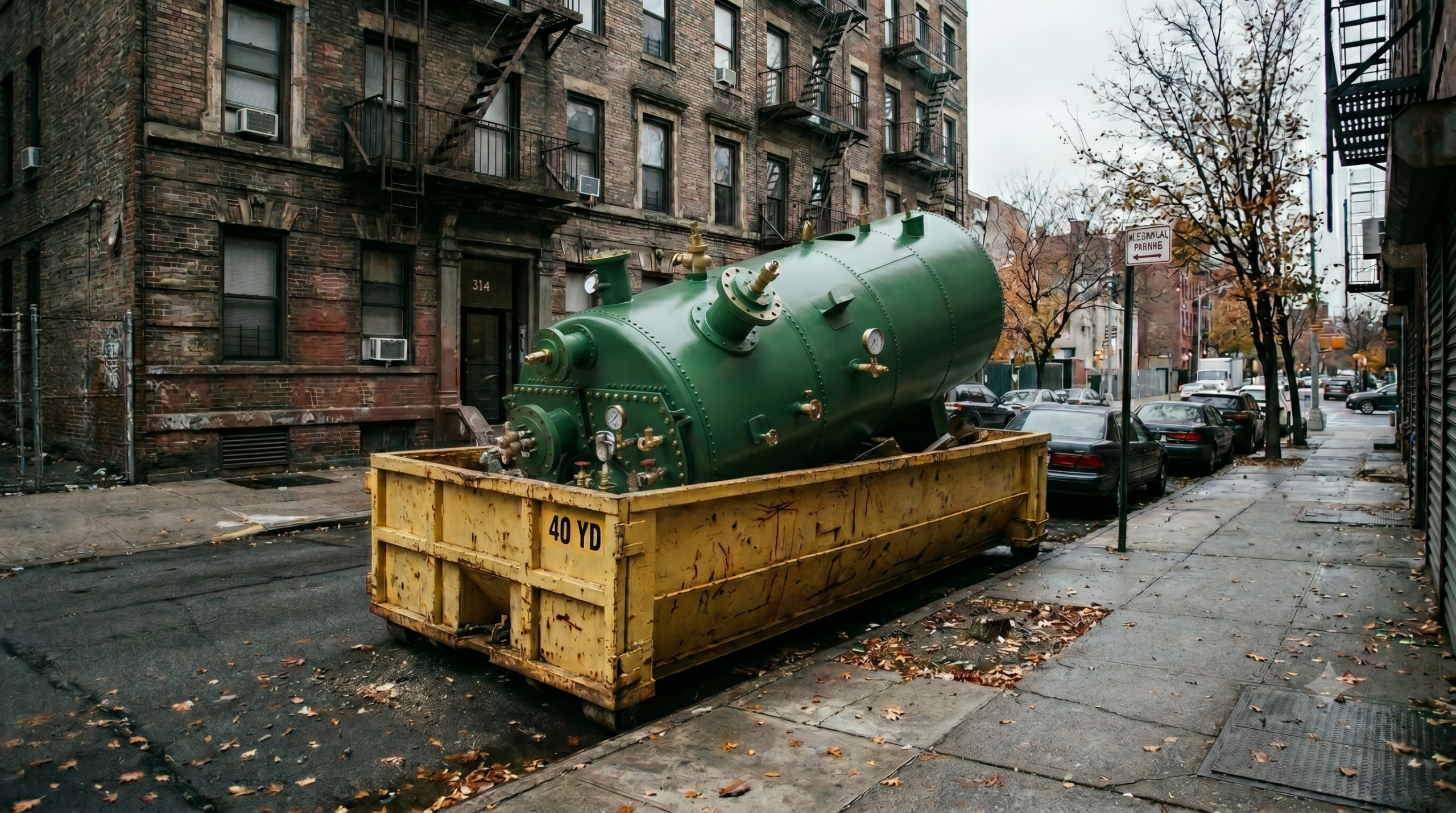
Tearing out a boiler plant with a decade of paid-for service still left in it — just to satisfy Local Law 97 — means writing off hundreds of thousands of dollars you’ve already spent. Truburn® cuts your counted emissions without the rip-and-replace, by changing the fuel, not the equipment.
The carbon target doesn’t require a demolition
Faced with LL97 emissions caps, owners running oil-fired plants are usually pointed at two conversions: electrify, or switch the plant to natural gas. One is an enormously expensive rip-and-replace. The other burns a fossil fuel that only gets you part of the way to your target — and leaves you exposed when the caps tighten again.
Both treat a perfectly serviceable, expensive piece of equipment as if it were worthless. That framing skips a question worth asking first: what is the boiler plant you already own actually worth — and how much life is left in it?
What a boiler plant like this is actually worth
Take a common mid-size setup: two 600-horsepower packaged firetube boilers — roughly 1,200 boiler hp, or about 40 million BTU per hour of combined steam capacity. That’s the kind of plant heating a large multifamily building, a campus loop, or an institutional facility.
This is not cheap iron. Engineering cost references like R.S. Means put an installed packaged firetube boiler and burner in the low-to-mid six figures for the unit alone — and on a turnkey project, that boiler is often the smaller half of the bill. The fuel train, combustion controls, feedwater and deaerator systems, breeching and stack, piping, electrical, demolition of the old units, engineering, and permitting typically account for another 40–70% of total project cost. Scaled to two 600-hp boilers in a NYC building — with code upgrades and union labor — a turnkey replacement is comfortably a seven-figure capital project, commonly $1.5 million or more. Owners then spend to keep it running: industrial boiler maintenance runs about 2–4% of installed capital per year, or roughly $30,000 to $60,000 a year here for tuning, water treatment, inspections, and parts.
The point isn’t that boilers are expensive. It’s that the owner has already paid for this one.
The sunk cost nobody puts in the spreadsheet
Here’s the line item the “just electrify” pitch leaves out. A steel firetube boiler has a useful life of about 25 years, per ASHRAE’s equipment-life guidance. A plant that’s been in service for 15 years isn’t at the end of the road — it has roughly a decade of reliable service left.
That remaining decade has a dollar value. Spread a $1.5 million plant straight-line across its 25-year life and it delivers about $60,000 of heating capacity a year. Scrap it at year 15 and you walk away from the final 10 years — roughly $600,000 of service you’ve already paid for but never collected. That forfeited value is a real cost of converting, and it stacks on top of the new capital, not instead of it.
So the honest price of ripping out a working plant is two numbers added together: the new capex, plus the unrecovered value of the old plant. For an electrification project, that can mean several million dollars in new heat-pump equipment plus a multi-megawatt electrical-service upgrade — DOE’s own case studies run as high as ~$10 million for a single large building — piled on ~$600,000 of stranded value. That’s before you count higher operating costs (per million BTU, electricity has recently run several times the cost of natural gas) or the inconvenient fact that on today’s gas-heavy Northeast grid, a resistance electric boiler’s real carbon benefit can be modest. All-in, you can easily spend $5–10 million or more and still not move your emissions number the way the brochure promised.
A fuel switch, not a capital project
Truburn® changes the equation by changing the fuel instead of the firebox. It’s a 100% renewable heating oil derived from used cooking oil, and it’s a drop-in replacement for #2 heating oil that works with existing oil-ready systems. The boilers you already own keep running — through the rest of their useful life — on a fuel that delivers a 93% lifecycle reduction in greenhouse gas emissions versus fossil heating oil, with 74% counted under LL97.
That’s compliance progress without a demolition: no stranded asset, no multi-month construction shutdown, no electrical upgrade, and no capital event to finance.
Your real options for an oil-fired plant
Once you count the value still sitting in the equipment you already own, the three routes look very different:
| Path to lower emissions | New capital required | Value forfeited in the old plant | All-in economic hit | Carbon outcome |
|---|---|---|---|---|
| Convert to Truburn® | Minimal — fuel switch only | None — full useful life captured | ~$0 incremental | 74% counted under LL97 (93% lifecycle) |
| Switch to natural gas | Six-figure burner/fuel-train conversion + gas service | Partial | Six figures + partial write-off | ~28% — still a fossil fuel |
| Full electrification | Several $M+ (multi-MW heat-pump plant + electrical-service upgrade) | ~$600K (10 of 25 years) | ~$5M–$10M+ | Limited today — depends on grid mix |
Electrification has its place — at true end-of-life, or once the grid is far cleaner than it is now. Natural gas trims emissions but locks the building into another fossil fuel and the next round of LL97 tightening. Only converting the fuel lets an owner capture the deepest counted reduction and collect the full value of a plant they’ve already bought.
Compliance and capital preservation — in one move
Sustainability shouldn’t mean discarding the value a building has already invested. Truburn® lets an owner cut counted emissions toward LL97 and run their existing boilers to the end of their service life — protecting capital while staying ahead of a tightening regulatory curve. The greenest equipment is often the equipment you don’t have to manufacture, ship, and install all over again.
Come See Truburn® Live — Schedule Your Tour
Want to see Truburn® in action? We invite NYC building owners and managers to tour an active Truburn®-powered building in Manhattan and see firsthand how easy the transition is.
Get in touch with Lifecycle Renewables:
- 📞 Call us: 888-461-9831
- 📧 Email: truburn@lifecyclerenewables.com
- 🌐 Website: truburnfuel.com
Sources & References
1. ASHRAE Equipment Life Expectancy guidance — steel firetube boilers ~25 years. hvac-eng.com
2. R.S. Means / Reed Construction Data, “Technology Cost Breakdown: Heating Boilers” (Consulting-Specifying Engineer) — installed boiler equipment + labor cost reference. csemag.com
3. U.S. EPA, “Regulatory Impact Analysis — Industrial, Commercial, and Institutional Boilers (Boiler MACT Remand),” 2022 — installed/compliance capital-cost estimates. epa.gov
4. Steam Boiler Cost Breakdown — controls, auxiliaries, and plant integration are 40–70% of total project cost. coalbiomassboiler.com
5. Industrial Boiler Total Cost of Ownership — maintenance ~2–4% of capital per year. coalbiomassboiler.com
6. U.S. Department of Energy, “Large Commercial Building Boiler Electrification Guide” — electrification depends on grid mix and often requires substantial electrical-service upgrades. energy.gov
7. Electric vs. Gas Steam Boiler operating-cost comparison (electricity ~2.4× gas per MMBtu, 2024 rates; resistance COP ≈ 1). epcbsteamboiler.com
8. NYC Department of Buildings, “Local Law 97 — Greenhouse Gas Emissions Reductions.” nyc.gov
9. Truburn® by Lifecycle Renewables, “Truburn Cuts Carbon Emissions by 93% — A Game-Changer for NYC.” truburnfuel.com
